Wednesday, 17 September 2014

Reinvention, Recycling, Re-purposing ..........

I have so many textiles in my collection. At the end of our dining table is a blanket chest with my vintage linen collection (three more tablecloths expected early next week - Shh!!) - it won't fit anywhere else! I have three linen baskets of yarn (No - mis-counted - four linen baskets of yarn), shrunk in 'vac-pac' bags, in the conservatory and the cupboards above our wardrobe have more - as does one of the drawers under our bed. One tall shelving unit and two chests of drawers are full of new fabric. My craft room has four large boxes of hand-dyed fibers and my collection of yarn 'snippets' for felting. Textiles for recycling are freshly washed and then store in large vac-pac bags (T-shirts, fleece, denim, other) - some are under the sofa in the conservatory, others in my craft room. I love creating things for our home - often combining new materials with 're-incarnated' ones - but I have too many our own use. So I have decided to offer some items for sale.

The focus of my work will remain embroidery. Embroidered vintage linens and left-overs from other projects have featured in my work for some time.


I shall soon open a new shop section for non-embroidered items.

I am just finishing a work basket like these - the new one in cream and rust:


The re-decoration of our 'breakfast' room is almost complete- I hope it will make a good backdrop for photos on sunnier days. The remnants of wall paper on this photo have now vanished and the wall has been filled and sanded so many times I'm surprised that there's any plaster left! The crisp, very white finish we now have doesn't look right with the lovely pale yellow in this blanket, so I've been working on making it square-shaped. It  needs another few squares and a lovely border.I'm going to do a trial wash on a couple of sample squares today, and, if all goes well, this will also be listed as a small throw/lap blanket. 


I'll never be able to produce these items in large numbers but I hope I'll find enough customers to help me re-home my stash in this way. 

In order to have some consistency in 'branding' ( yuk!! that phrase doesn't sit well with the way I feel about my work - sounds too 'hard-faced' and commercial, although perhaps this is why my Paypal account doesn't overflow!!) I may try producing some hand-embroidered 'Lynwoodcrafts' labels for these items. What do you think?

Thursday, 13 February 2014

More 'How to' make textile beads


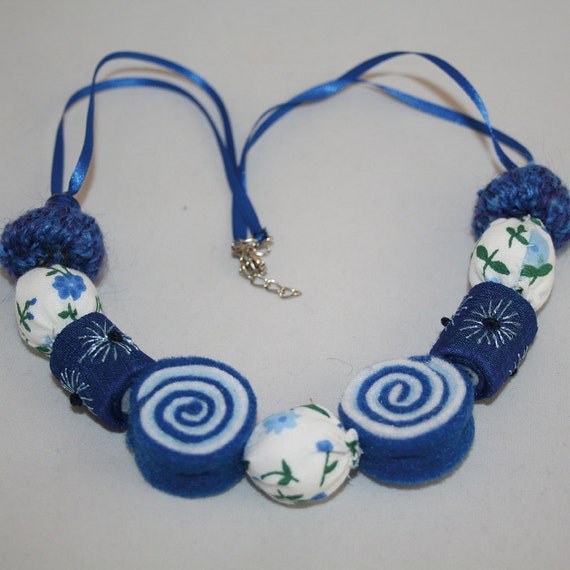
The weather has been somewhat challenging lately. I find working with colour a good way to raise my spirits, so I have enjoyed making this necklace today. ( Now listed in my Folksy shop just click on the photo to take a closer look).

I am amore than a little behind with my how to make beads series - but I'm pretty sure that I took photos for at least one more type so I'll just check.....  found them!

---o0o---

Cylindrical Beads - based on a roll of felt


You will need:

- Small strips of felt - as wide as the finished bead - long enough to roll up to the desired diameter - try about 10 cm to begin with
- Matching thread
- paper craft straws
- double sided adhesive tape
- Usual sewing equipment - needle, pins etc.
- Fabric to cover the felt - if desired. I have photographed the process using an outer layer of an organza


Cut a strip of organza wide enough to wrap round a felt strip and long enough to completely cover the bead outer ( plus turning) - it is not necessary to cover the entire felt strip, much of which will be hidden in the centre of the roll.


Cut a short length of craft straw - shorter than the width of the felt strip so that it will not show - this will form the threading channel. Wrap the straw length in double sided adhesive tape. Place on the reverse side of the felt (ie folded in edges of organza on top) and place the straw near the edge of the un-covered end. 


Roll the felt tightly around the straw and secure with a pin through the fabric only!


Using the matching thread oversew the edges to secure the bead.


These are destined to be embroidered in gold thread.

--------

Endless variations are possible. So far, I have used silk in place of the organza, used torn fabric strips (these don't need folding under - complete the bead using felt only and then wrap in the fabric and stitch to secure), ribbon - plain (to be embroidered) or patterned - again, make the bead first then cover. 

Most of all Have Fun!

Monday, 27 January 2014

Textile beads 2 - How to Knit Spherical Beads


I promised you a knitting pattern for beads in this next post, so here it is! I displayed these in cake cases - they almost look like pretty truffles!

You will need:

- a small quantity of knitting yarn - 3 or 4 ply preferably
- a small quantity of polyester wadding
- a paper craft straw
- pair of 2.25 (old size 13) knitting needles
- usual scissors and large eyed sewing needle.


Method

- Begin by casting on 4 stitches
- Row 1 - Knit twice into each stitch to end (8 stitches)
- Row 2 - Purl 1, purl twice into next stitch, to end (12 stitches)
- Row 3 - Knit twice into each stitch to end (24 stitches)
- Row 4 - purl
- Row 5 - knit.
- Row 6 - purl.
- Row 7 - knit.
- Row 8 - purl.
- Row 9 - knit 2 together to end ( 12 stitches).
- Row10 - purl 1 purl 2 together to end (8 stitches).
- Row 11 - knit 2 together to end ( 4 stitches).


Break yarn leaving about 6 inches attached. Using a needle thread the yarn end through the four stitches on the knitting needle and remove from the knitting needle. I  have chosen to use the beads as reverse stocking stitch (knit rows showing). Turn the knitting so that the 'knit' rows are downwards. Place a small quantity of polyester wadding into the 'bead'. Lay a craft straw across the bead on top of the wadding.


Stitch about half way up the side of the bead, using the attached yarn. Using the point of your scissors, or similar, carefully push in more wadding on top of the straw, taking care to create a spherical shape. Stitch until almost closed. Push in a little extra wadding if necessary and end off the yarn.


Stitch both yarn ends back through the bead to hide them - taking care not to stitch through the straw. Cut off close to the bead. Push the bead to one of the craft straw. Slightly compress the bead towards the end of the straw, taking care not to let the bead slip off the straw. Trim the straw close to the bead. When the bead is released and expands the straw should not be visible but will provide a chanel for threading the bead without risk of dragging the stuffing out.


Admire your work and choose the yarn for your next bead. Have fun!

----o0o----


Saturday, 25 January 2014

Textile Beads


This post will end with the first 'how to' of a series ( please scroll down if that's your main interest ), but, before I get to that:

Why am I making textile beads?

The absolutely honest answer is that I enjoy stitching them and I like the results of my work. 

In an attempt to justify the time I have spent this week there are some other factors:

- Lynwoodcrafts' brooches continue to be my best sellers. I had a very limited selection of other jewellery items.

- I have a huge collection of all the yarns, thread, fabrics I might expect to need - the possibilities for shape/colour etc are endless.

- Small beads lend themselves to the use of re-purposed fabric, this will always be mentioned in the listing where used. I am committed to the recycling of all textiles used in my household - one way or another!

- My customers tell me that they buy from me for one of two reasons. The item will be a gift ( I hope a wider range of jewellery might appeal to gift shoppers), or else the purchaser is treating herself (most of my customers are female) to an unusual item she won't find elsewhere.

There are many, many jewellery  sellers on all the main craft selling sites. I hope my unique items will have an appeal which will set them apart. I shall, of course, continue to make and offer for sale Lynwoodcrafts' range of other embroidered accessories - purses, pincushions, notebooks, bookmarks etc. - when I can tear myself away from these beads!

These are the items which I have listed so far:
Milliebead Pauline Skidmore
Minifelts The Owl & the Pussycat
Little crafting bird D K Crystal Designs

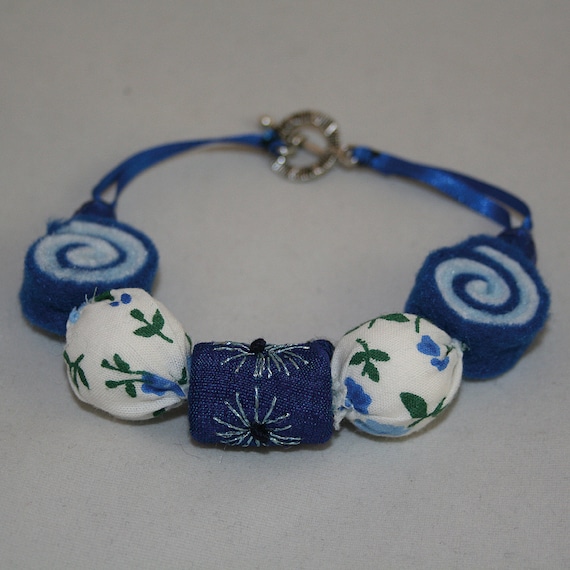
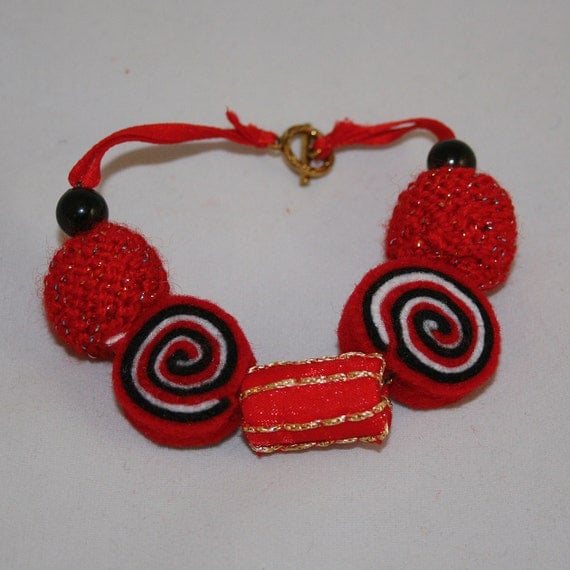
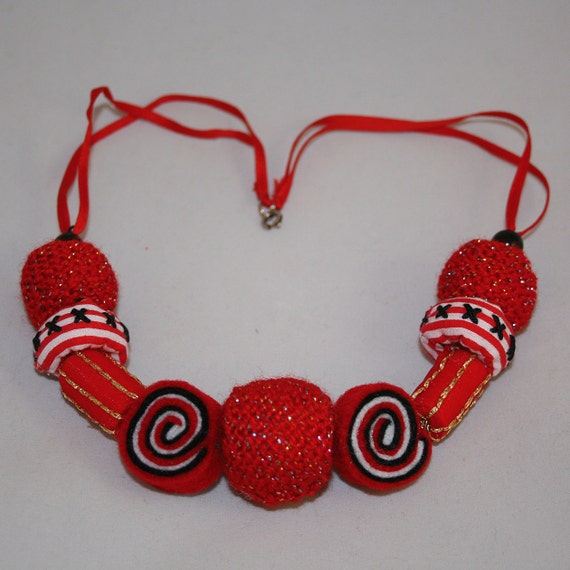
The first four items all include 'felt pinwheel' beads. These are quite simple, so, as this post is already quite long, I'll begin the 'how to's' with these.

------o0o------

FELT PINWHEEL BEADS

You will need:

- At least two colours of felt (I have chosen three) - small strips (about 1cm x 12 cm of each colour per bead)

- Matching thread

- usual pins/needles/scissors etc.

Lay your felt pieces one on top of the other, one edge alligned, and roll tightly to see what effect the colour combination  has. Changing the order of the felt colours makes quite a difference to the overall colour balance - try swapping them until you have a combination you are happy with.

Cutting through all three layers at once, cut a strip about 1cm wide and approximately 12 cm long (this can be adjusted slighlty to give different bead diameters).

Leaving the outer (bottom colour of the stack) at full length - trim each end of the upper layer(s) by about 3 mm.


Roll the stack tightly - 'swiss roll fashion' and stick a long pin through to hold. Using matching thread, oversew the edge of the roll. Then take a long stitch right through to the opposite side of the bead (12 o'clock). Making a stitch of a few milimeters come back to the join (6 o'clock). Then stitch through the bead to '3 o'clock' in the above picture and from there to '9 o'clock ' and back to the join '6 o'clock'- finish off. Be careful not to pull these long stitches too tight or the shape of the bead will be distorted. 

To use the bead, stitch the beading thread through from join to the opposite side - this way the join is most likely to be hidden by a neighbouring bead!


Have fun! The next 'bead recipe' will be the knitting pattern for the spherical bead shown above. I am busy making several in different yarns to show you some of the effects possible.

Thursday, 16 January 2014

LInen and Lace Pincushion - and others


This is a small selection of the other pincushions and needle books currently available from Lynwoodcrafts:


I spent an enjoyable few hours yesterday working through my little horde of linens and lace awaiting recycling, trying to decide the best ways to cut and reuse the most decorative parts of the items. I ended up piecing together a collection of pincushions. This is the first:


The scalloped edge of a table mat was used as an applique panel for this one - once embroidered with a rose motif, I think it looks quite effective. The lace and button are also vintage finds.


Tuesday, 14 January 2014

Winter Inspiration

I am determined to brave the dreadful weather and get out and about harvesting inspiration for future work. At this time of year the shapes, twists and textures of the trees are clearly visible, the few flowers which dare to show their faces are a delight to find, frost creates art work all of its own and the quality of frosty air on a winter's day clears my mind!

This brooch resulted from an earlier walk:

il_570xN.377042563_fvke.jpg


and this from another:

main.jpg


The garden can still provide some inspiration in winter - such as this winter-flowering jasmine:

main.jpg


I have spent a little while taking a 'virtual outdoor stroll' around Etsy and I have compiled this treasury as a result:


Tuesday, 10 December 2013

Bright and Cheerful Crocheted Bowl


Not exactly a recycling project this time - since I bought the coloured twine with something like this in mind! I just loved the colours and they were too good to use for the bean canes in the garden!


The quantity of twine more or less dictated the size and shape. In order to make the coloured stuff go further the base of this bowl is worked in parcel twine which I happened to find next to the tape dispenser. One row of double and one of treble (the first of the bowl side) were worked in the bright pink, Then one of treble in 'indigo' followed by a second treble row with alternate trebles replaced by as ingle chain - this produced a saving in twine and had the effect of curving the top of the bowl inwards slightly. Producing close work in quite stiff twine has been quite tiring for my hands. I have lime green and turquoise left, together with small quantities of indigo and pink and more parcel twine, a second bowl will follow in due course.


This first one has been put to good use as a temporary container for 'daisy brooch' background panels - awaiting their daisies!!