Almost 7 weeks ago, I set out for a walk on fresh snow, wearing good walking boots, and returned 6 hours later, via A&E with a fractured right wrist. Last week the plaster was removed. I now need to work at some exercises to try to recover the use of the wrist and my dexterity. I have been warned that it will be a long process!
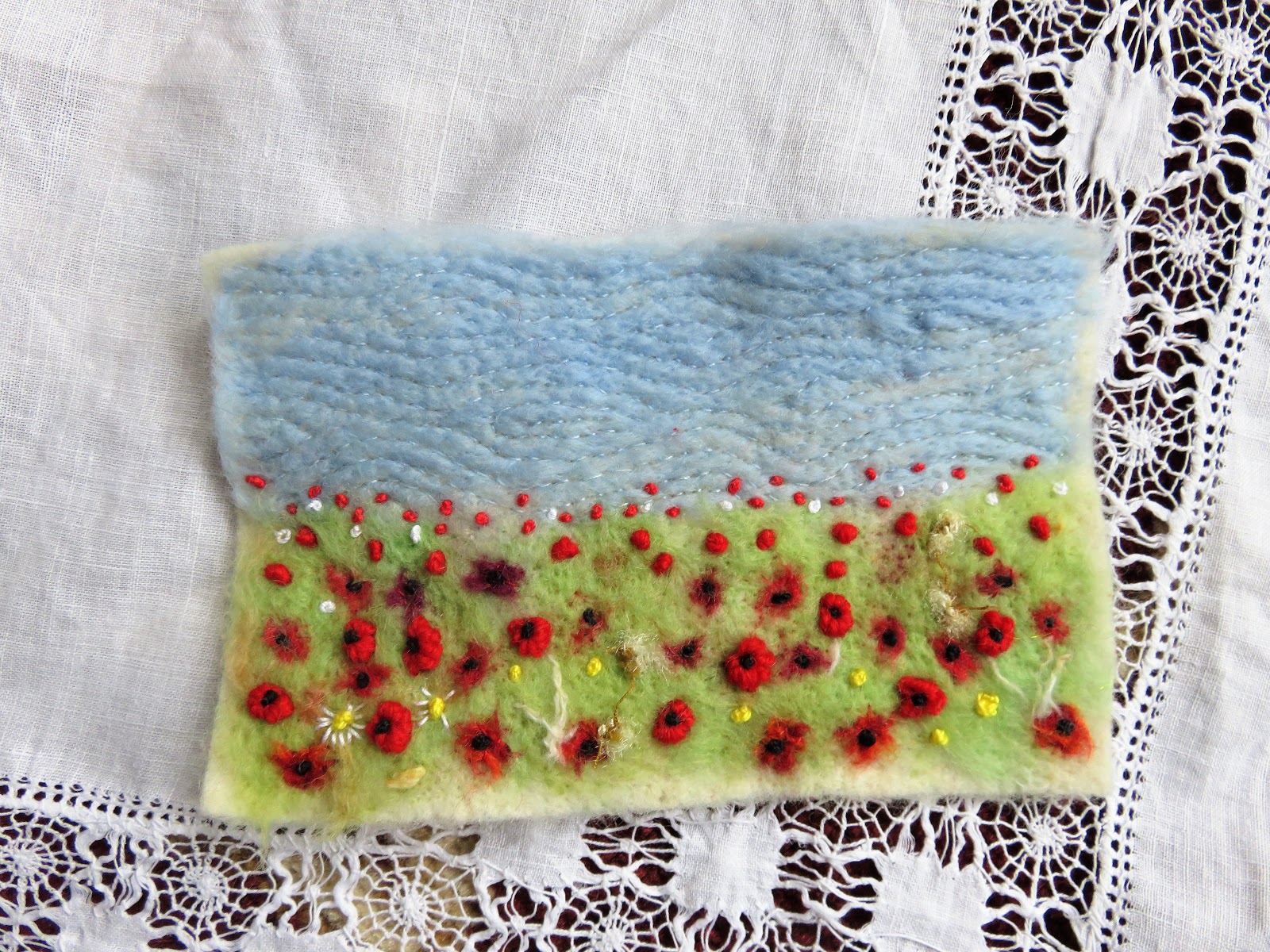
I have taught myself to stitch left handed but now I want to return to my original stitching style - my shops lack stock of popular items. I have managed some progress on this felted and embroidered poppies needle case. My left hand still makes a significant contribution.
My Sustainability Audit - Part 2
Food
We have always enjoyed preparing food from basic ingredients. We grow as many fruit and vegetables as we can manage in a smallish garden and have tried to support fair trade and organic production. My choices are restricted a little by my need to follow a gluten-free, dairy-free diet.
I have become concerned that we are not making careful enough choices from a sustainability point of view. Since the beginning of this year, we have tried to change our food buying habits. We were doing well, pre wrist fracture - I am not able to participate fully at the moment and since, most household tasks are no longer shared, time is at a premium.
This is a summary of our approach so far:
- I am aware that a diet based on eating meat is not sustainable globally. The latest advice seems to be that we should be moving to a weekly diet based on up to two portions of chicken, two portions of fish, red meat to the equivalent of one small burger and one egg. I am surprised about the limit of one egg and need to understand the reasons for that. We enjoy eating meat and don't feel ready to reduce our consumption to this level but we now eat meat no more than 3 times per week and have reduced our portion sizes. I must explore more vegan baking recipes - at the moment we significantly exceed the one egg limit.
- We try to buy locally produced foods. At the very least, UK produced foods - seasonally available and with no airmiles. Good welfare standards in meat production are important to us and the cost is someway offset by smaller portions and fewer meat meals.
- We were, pre wrist fracture, exploring more vegetarian recipes and will enjoy returning to doing so. We provide our own tomatoes for about 6 months every year. Other home grown produce includes - peas, runner/French/broad beans, salad leaves, herbs, courgette, red peppers, cucumber, chillies, beetroot, radish, desert apples, cherries, strawberries, blackcurrants, red currants, raspberries, gooseberries, rhubarb. This year we are trying squashes. We don't have enough space for many potatoes but container-grow a few to enjoy the flavour, we also grow a few carrots and parsnips.
- We batch cook and freeze soups and stews. We use cooking fuels sparingly (being economical with the use of the oven etc) - perhaps we need to improve in this respect and I'm not sure about the use of the freezer. I intend to look into bottling as one alternative.
- I am very conscious of making choices so as to reduce packaging - particularly plastic. I have a supply of paper bags ( I intend to make some fabric produce bags when I can) and buy loose veg as much as possible. I don't yet have a source of non-plastic wrapped rice for example.
- Food waste has never been too much of an issue for us. My bread is an expensive luxury so carefully consumed. I intend to try gluten free recipes and return to making my own when my wrist permits. We cook sensible portions - sometimes deliberately creating 'left overs' for my next day lunch. Peelings are composted. Any meat trimmings, or scraps of cooked food, are disposed of in our local authority food waste caddy - it is always nearly empty!
We enjoy our food - growing it, purchasing it, preparing it and eating it. I hope to show progress towards better sustainability in future posts.
Tuesday, 19 March 2019
Thursday, 28 February 2019
My Sustainability Audit
This is not going to be scientifically done - I'm not clever enough, or well enough informed for that! I just wish to enter the conversation, to try and state where I am now, hoping that future posts will allow me to show improvement. By reading posts and discussions on-line I have become aware of issues which had not occurred to me, things which I can do better, points which I need to research further - I want to participate in a small way. This blog focusses on my craft activities, but set in the context of my family life, other activities and inspirations. Sustainability has become a major influence in all aspects of my life, but I am keenly aware that I have much progress to make. I want to encourage myself to do better without becoming dispairing and so need to allow myself to recognise that I have already made some progress.
So - to make a start! I am going to attempt to consider the sustainability of my life in four 'aspects' -
Fuel
Food
Textile and other purchases
Recycling and Waste Management.
I feel that I have made more progress in some areas than others. I'll deal with one 'aspect' at a time, so, for this post, I shall consider 'Fuel'.
My use of Fuel
I am sure my views will change as information changes and new products become available. We have many improvements to make. I warned you that this will not be scientific - I think a list of bullet points, as they occur to me, is the best I can do:
- Transport. We have two vehicles - one petrol fuelled, one diesel. We are not in a position to change them at present and I'm not sure that the solutions, currently available, would suit us. So, to do the best we can in the meantime, we are using them as little and as efficiently as possible. The combined annual mileage is about 10,000 miles. Both vehicles are well maintained, we have tried to reduce both total miles and, particularly 'urban miles'. The petrol car goes to work (a few urban miles away) with my husband. He tries to shop whilst already in town. If I need a few items, or the Post Office, I walk - a 3 mile round trip. I work from home. I have the car one day each week and organise any miles I drive into one efficient trip - including the most accessible recycling centre. Week end leisure trips and holidays are spent on campsites, travelling in our diesel vehicle. Once arrived, we try to use public transport or walk - having chosen sites with this in mind. Unfortunately, our bus service at home has been drastically reduced and we have to walk about 2 miles to pick up more frequent services. Holidays are taken in the UK or by a ferry journey. We do not fly.
We try to make food purchases with airmiles in mind - buying seasonal UK produce when possible.
- Domestic Heating. We live in a typical late 1920's semi. Not a brilliant starting point! We have good loft insulation but do not have cavity wall insulation - we prefer to maintain the cavity as it was designed to be. We have an elderly gas boiler and a hot water cylinder - so we need to make improvements. We do not want to change to a newer combi boiler since we feel this would be an interim measure - we need to get way from the use of gas, and we couldn't afford a short term change then a more permanent one. I am not sure what our options are. I know that a recent report has urged the government to insist on a ban on fossil fuel heating for new homes from about 2025. I hope that new options will become viable for us. We had an audit for solar panels but our house roof was unsuitable and our garage would not have been financially viable. We may revisit this. In the meantime, we use the boiler for heating from beginning of December until the end of March at the latest. Except for Christmas week, when our kids are at home, it is only on for one hour in the morning and one hour in the late afternoon. Thermostats are turned down, particularly in the bedrooms. We wear warm clothing and don't like to be too hot. It is rare for us to use the boiler for more hours a day. We use a fan heater with a thermostat in the sitting room, if necessary, usually only in December and January. I work from home and confess to sometimes feeling a little chilly but we survive. We expect to live in this house in our retirement, when we may need to be a little warmer, and may need more heating in the bedrooms, so we need a better solution.
Domestic water heating is on for one hour in the morning and half an hour in the late afternoon throughout the year. Always turned off when we are away. It is used for one of our two shower units - we should aim to replace this, hand washing, washing up and very occasional baths. I prefer to wash my hands in warm water. We remove any food waste from breakfast and lunch crockery into the food waste caddy, rinse in cold water and keep until the evening to be washed up with items from our evening meal ( also scraped and rinsed) - we only use one washing up bowl of hot water this way. I occasionally hand wash textiles for my work. I shall try to reduce the water heating time further, but we need better solutions. Could I still find 'individual local' water heaters, for each sink and basin, heating by electricity? If so, forgo the bath, replace the shower and the problem of domestic hot water would be solved.
- Domestic Appliances and Lighting Our washing machine, tumble dryer, ovens (electric) and vacuum cleaner are all only a few years old and chosen with efficiency in mind - our dehumidifier, fridges and freezers are older. I am sure more efficient models will become available, however, the wider issues of sustainability suggest to me that we should maintain and repair the ones we have and use them sparingly. The tumble dryer is for occasional use only - we line dry when possible or air indoors but then use a dehumidifier. I have returned to an old fashioned wash day now there is only laundry for two. I find I can organise loads into fewer washes and we reduce the use of the dehumidifier to one day. We wash at 30 degrees. When we use an oven we try to be efficient - main savoury and pudding and/or cakes at same time. We have a fridge and fridge/freezer in the house and another freezer in the garage. We batch-cook and feeze and we also store produce from our garden. I need to give more thought to the use of these. We have replaced our downstairs carpets with hard flooring and rugs. I brush at least daily and vacuum once a week.
All suitable light fittings now have LED lamps - turned off when not in use. We need to replace the fittings in the kitchen and utility room.
Our hob is gas. We should be aiming to replace this - I think the current advice is electric induction. Our old one is built in and we might need to replace the work surface and, consequently, re-tile. I'd like to investigate the water heating issue before changing the hob and try to just have one disruption.
In addition, we use electricity for garden and, occasionally, DIY appliances, for ironing, TV and music, phones, computers, tablets, sewing machines but have worked hard to reduce our overall consumption.
So - to make a start! I am going to attempt to consider the sustainability of my life in four 'aspects' -
Fuel
Food
Textile and other purchases
Recycling and Waste Management.
I feel that I have made more progress in some areas than others. I'll deal with one 'aspect' at a time, so, for this post, I shall consider 'Fuel'.
My use of Fuel
I am sure my views will change as information changes and new products become available. We have many improvements to make. I warned you that this will not be scientific - I think a list of bullet points, as they occur to me, is the best I can do:
- Transport. We have two vehicles - one petrol fuelled, one diesel. We are not in a position to change them at present and I'm not sure that the solutions, currently available, would suit us. So, to do the best we can in the meantime, we are using them as little and as efficiently as possible. The combined annual mileage is about 10,000 miles. Both vehicles are well maintained, we have tried to reduce both total miles and, particularly 'urban miles'. The petrol car goes to work (a few urban miles away) with my husband. He tries to shop whilst already in town. If I need a few items, or the Post Office, I walk - a 3 mile round trip. I work from home. I have the car one day each week and organise any miles I drive into one efficient trip - including the most accessible recycling centre. Week end leisure trips and holidays are spent on campsites, travelling in our diesel vehicle. Once arrived, we try to use public transport or walk - having chosen sites with this in mind. Unfortunately, our bus service at home has been drastically reduced and we have to walk about 2 miles to pick up more frequent services. Holidays are taken in the UK or by a ferry journey. We do not fly.
We try to make food purchases with airmiles in mind - buying seasonal UK produce when possible.
- Domestic Heating. We live in a typical late 1920's semi. Not a brilliant starting point! We have good loft insulation but do not have cavity wall insulation - we prefer to maintain the cavity as it was designed to be. We have an elderly gas boiler and a hot water cylinder - so we need to make improvements. We do not want to change to a newer combi boiler since we feel this would be an interim measure - we need to get way from the use of gas, and we couldn't afford a short term change then a more permanent one. I am not sure what our options are. I know that a recent report has urged the government to insist on a ban on fossil fuel heating for new homes from about 2025. I hope that new options will become viable for us. We had an audit for solar panels but our house roof was unsuitable and our garage would not have been financially viable. We may revisit this. In the meantime, we use the boiler for heating from beginning of December until the end of March at the latest. Except for Christmas week, when our kids are at home, it is only on for one hour in the morning and one hour in the late afternoon. Thermostats are turned down, particularly in the bedrooms. We wear warm clothing and don't like to be too hot. It is rare for us to use the boiler for more hours a day. We use a fan heater with a thermostat in the sitting room, if necessary, usually only in December and January. I work from home and confess to sometimes feeling a little chilly but we survive. We expect to live in this house in our retirement, when we may need to be a little warmer, and may need more heating in the bedrooms, so we need a better solution.
Domestic water heating is on for one hour in the morning and half an hour in the late afternoon throughout the year. Always turned off when we are away. It is used for one of our two shower units - we should aim to replace this, hand washing, washing up and very occasional baths. I prefer to wash my hands in warm water. We remove any food waste from breakfast and lunch crockery into the food waste caddy, rinse in cold water and keep until the evening to be washed up with items from our evening meal ( also scraped and rinsed) - we only use one washing up bowl of hot water this way. I occasionally hand wash textiles for my work. I shall try to reduce the water heating time further, but we need better solutions. Could I still find 'individual local' water heaters, for each sink and basin, heating by electricity? If so, forgo the bath, replace the shower and the problem of domestic hot water would be solved.
- Domestic Appliances and Lighting Our washing machine, tumble dryer, ovens (electric) and vacuum cleaner are all only a few years old and chosen with efficiency in mind - our dehumidifier, fridges and freezers are older. I am sure more efficient models will become available, however, the wider issues of sustainability suggest to me that we should maintain and repair the ones we have and use them sparingly. The tumble dryer is for occasional use only - we line dry when possible or air indoors but then use a dehumidifier. I have returned to an old fashioned wash day now there is only laundry for two. I find I can organise loads into fewer washes and we reduce the use of the dehumidifier to one day. We wash at 30 degrees. When we use an oven we try to be efficient - main savoury and pudding and/or cakes at same time. We have a fridge and fridge/freezer in the house and another freezer in the garage. We batch-cook and feeze and we also store produce from our garden. I need to give more thought to the use of these. We have replaced our downstairs carpets with hard flooring and rugs. I brush at least daily and vacuum once a week.
All suitable light fittings now have LED lamps - turned off when not in use. We need to replace the fittings in the kitchen and utility room.
Our hob is gas. We should be aiming to replace this - I think the current advice is electric induction. Our old one is built in and we might need to replace the work surface and, consequently, re-tile. I'd like to investigate the water heating issue before changing the hob and try to just have one disruption.
In addition, we use electricity for garden and, occasionally, DIY appliances, for ironing, TV and music, phones, computers, tablets, sewing machines but have worked hard to reduce our overall consumption.
----o0o----
To return to my craft theme, a collage of a few items from upcycled textiles, available from my Folksy shop Lynwoodcrafts Recycled.
Saturday, 9 February 2019
Boro Beginnings - more serendipity
I have been wanting to try 'boro style' stitching - hoping to create textured backgrounds from fragments of cloth, on which to create stitched designs. I hoped to produce bags, notebook covers, needlebooks etc - all entirely hand-stitched. I have experienced a temporary change in stitching direction since my last post! I have fractured my right wrist - a slip in the snow whilst out for my daily walk and photo session. I think I have some lovely snowy images but an unwelcome legacy!
I am very grateful to the team on duty at my local A&E who managed a successful manipulation of the fracture and enabled me to avoid surgery. The fracture clinic staff have also been brilliant. A young nurse, who completed the 'half plaster' for me, earned a sideways 'pointed stare' from a senior colleague for commenting on how beautiful the colours and patterns of the bruising round my elbow are. I wasn't offended in the least - I would be very happy to create a paint effect or marbling pattern resembling the bit I can see of the 'natural art work'.
So single-handed, left-handed stitching for a right-handed sewer! I have at least 6 weeks to perfect the technique! I managed to secure a panel of fabric to the webbing on a tapestry frame - my tacking good enough to achieve a reasonable tension. I found I can iron fabric one handed, struggled to pin scraps in place - coaxing my injured hand to help me, and so began stitching. A needle held upright in a ball of thread - light from the window behind the eye of the needle, was threaded - after several attempts. I need to work from both sides of the frame. I can place the entry of the stitch (with increasing accuracy), I then need to draw the thread through and stab the return of the stitch back from the wrong side. A slow process but one in which I am increasingly able to achieve a pleasant and very triumphal rhythm. I am using fairly long lengths of thread in an attempt to reduce the very frustrating re-threading of the needle!
I tend to be very 'finnicky' with my normal right-handed work. I hoped for something a little more 'rustic' from this form of darning. It turns out that 'rustic' is an affect which my left hand manages brilliantly!! I am gradually becoming more precise in my stitching but hope not to become too accomplished! The background produced will then be embellished to form a bag for my own use. I have no intention of allowing the embellishment to hide much of the irregular stitching of which I am so ridiculously proud!
I am very grateful to the team on duty at my local A&E who managed a successful manipulation of the fracture and enabled me to avoid surgery. The fracture clinic staff have also been brilliant. A young nurse, who completed the 'half plaster' for me, earned a sideways 'pointed stare' from a senior colleague for commenting on how beautiful the colours and patterns of the bruising round my elbow are. I wasn't offended in the least - I would be very happy to create a paint effect or marbling pattern resembling the bit I can see of the 'natural art work'.
So single-handed, left-handed stitching for a right-handed sewer! I have at least 6 weeks to perfect the technique! I managed to secure a panel of fabric to the webbing on a tapestry frame - my tacking good enough to achieve a reasonable tension. I found I can iron fabric one handed, struggled to pin scraps in place - coaxing my injured hand to help me, and so began stitching. A needle held upright in a ball of thread - light from the window behind the eye of the needle, was threaded - after several attempts. I need to work from both sides of the frame. I can place the entry of the stitch (with increasing accuracy), I then need to draw the thread through and stab the return of the stitch back from the wrong side. A slow process but one in which I am increasingly able to achieve a pleasant and very triumphal rhythm. I am using fairly long lengths of thread in an attempt to reduce the very frustrating re-threading of the needle!
I tend to be very 'finnicky' with my normal right-handed work. I hoped for something a little more 'rustic' from this form of darning. It turns out that 'rustic' is an affect which my left hand manages brilliantly!! I am gradually becoming more precise in my stitching but hope not to become too accomplished! The background produced will then be embellished to form a bag for my own use. I have no intention of allowing the embellishment to hide much of the irregular stitching of which I am so ridiculously proud!
Tuesday, 29 January 2019
A New Year and a new beginning for some old textiles
I am increasingly drawn to re-purposing textiles. I am learning, adapting and, perhaps, improving, as I go along. I love to use changes in colour and texture.
Some while ago, I had a wonderful session with some vintage laces and my silk paints. I was aiming for 'gentle' colours so I added quite a lot of water to my mixed paints. I was thrilled with the muted pastel colours that resulted. The lace became very wet whilst working and I deliberately encouraged the colours to blend one into the next. I also painted some tapes, bias binding, ribbon and coiled lengths of thread and yarn (cotton and wool).
A little serendipity always adds just a little magic. I hate wasting anything - dilute paints included, so I placed the lace on top of various fabric scraps - some damask, a cotton sheet, and a fragment of drawn-thread work. A second layer of sheeting was under everything. The paint flowed through the lace, tapes and thread and created wonderful patches of coordinating colour on the fabrics underneath. The top layers were quite well covered. I deliberately added 'splodges' of paint to spread across any blank areas. The bottom layer achieved an effect of 'splodges of colour' on the original vintage background. Some of the lace fragments were really very wet - so much so that I was able to use them to 'print' a shadow of the lace onto plain sheeting.
I now have great riches - vintage lace, threads, tape, ribbon, binding and fabrics in gentle coordinating colours. The image shows the beginnings of two projects. I have added some lovely vintage cotton thread, in pale blue, which had been sun-bleached at one end of the skeins - more serendipity as the thread is now shaded beautifully.
Some while ago, I had a wonderful session with some vintage laces and my silk paints. I was aiming for 'gentle' colours so I added quite a lot of water to my mixed paints. I was thrilled with the muted pastel colours that resulted. The lace became very wet whilst working and I deliberately encouraged the colours to blend one into the next. I also painted some tapes, bias binding, ribbon and coiled lengths of thread and yarn (cotton and wool).
A little serendipity always adds just a little magic. I hate wasting anything - dilute paints included, so I placed the lace on top of various fabric scraps - some damask, a cotton sheet, and a fragment of drawn-thread work. A second layer of sheeting was under everything. The paint flowed through the lace, tapes and thread and created wonderful patches of coordinating colour on the fabrics underneath. The top layers were quite well covered. I deliberately added 'splodges' of paint to spread across any blank areas. The bottom layer achieved an effect of 'splodges of colour' on the original vintage background. Some of the lace fragments were really very wet - so much so that I was able to use them to 'print' a shadow of the lace onto plain sheeting.
I now have great riches - vintage lace, threads, tape, ribbon, binding and fabrics in gentle coordinating colours. The image shows the beginnings of two projects. I have added some lovely vintage cotton thread, in pale blue, which had been sun-bleached at one end of the skeins - more serendipity as the thread is now shaded beautifully.
Thursday, 20 July 2017
Hay-on-Wye and a patchwork vase
We were on our way home from a weekend in Cardiff, visiting our student daughter, and we stopped off at Hay-on Wye for a couple of hours. After business hours on a Sunday, the town was quite quiet and we were able to potter around taking a few photos.
Renowned for its book shops, Hay is very pretty. This shop front is beautiful!
We found a lovely antiques emporium and I bought a table runner to add to my collection of vintage linens for re-purposing.
Renowned for its book shops, Hay is very pretty. This shop front is beautiful!
We found a lovely antiques emporium and I bought a table runner to add to my collection of vintage linens for re-purposing.
---o0o---
This vase represents my latest recycling project (click the image below to visit its Folksy shop shelf):
Tuesday, 18 July 2017
Boston, birds and a wood mouse
The final episode of our Lincolnshire meander. Our very pretty campsite was just a few miles from Boston which we visited on the way. We were, initially, a little disappointed with the town. It was expensive to park our 'van', the market was large but not the sort of traders we prefer and the Tourist Information Office was in the museum which was 'closed for a private function' - on a Saturday morning! We had wanted to visit the museum, housed in the old Guildhall, had intended to consult Tourist Information for other points of interest, and the adjacent Fydell House was closed for the same function. Not very welcoming we felt!
We photographed the river and 'docks' from which the famous boats left for America (unfortunately low tide so more mud than water - not Boston's fault this time!), Saint Botolph's Church Tower, known as 'the Stump', and looked at the old merchant's houses and warehouses on the quayside. After a flash of inspiration we asked the way to the library. At this point, Boston redeemed itself since the library was still open (now mid Saturday afternoon when many would have closed at lunch time), a very helpful librarian (embarrassed to hear of the closed Tourist Information office), gave us a street map and suggested a visit to the Maud Foster Windmill, even suggesting a pleasant route to walk. The windmill was a wonderful place to visit - although to those of us with a gluten-free diet a little too 'floury'. There was a strong breeze, the sails were rattling round, the miller was very informative, the view was wonderful (between sails that is) and we very much enjoyed our visit. My husband is still enjoying the piza bases which he makes with semolina flour purchased from the mill shop!
After a restful night at the campsite, we trundled off again in the van to RSPB Frampton Marsh - the Lincolnshire side of the wash. I was a little uncertain if I would enjoy the trip. I can recognise our garden birds and those on our local hillsides, but wading birds are a bit of an unknown to me. It was a brilliant day out - aided by glorious weather. The volunteers staffing the visitor centre were knowledgeable and very patient even though I clearly knew very little. A visiting crane seemed to have created a commotion - its arrival heralded by texts from further along the coast. It was greeted by a long-lens, tripod carrying crowd. We felt very inferior and left them to it. The crane clearly tried to avoid them too and we had a lovely view as it flew over back to the Wash - sadly, my slow reactions and basic camera left me without a photo - although I did feel a little smug when some lens-laden twitchers struggled up the dyke to ask if we knew which way it had gone since they had missed it. The reserve is being grazed by my favourite cows - a small group of Belted Galloways so I couldn't resist a photo or two. There were many wildflowers for my stitching inspiration files too!
As we walked back to the car park, we saw a small furry bundle on the very hot road. It was a tiny woodmouse, very hot and I feared dehydrated - it seemed barely able to move. Keeping a watch for approaching vehicles I poured a little puddle of water in front of it and splashed a drop onto its nose. It revived enough to have a few sips from the puddle. I repeated the exercise and it drank more. Cute though it was I had no intention of being nipped - I remember the strawberry eating jaws of a similar cute beastie from a year or two earlier at home (images on facebook here). I broke a stalk from the verge seeking to use it to administer a gentle nudge back towards the verge. The mouse came to life enough to nibble the end of the stalk and, when I seemed to be about to remove it, clamped his teeth on tightly and held on whilst I lifted him to the relative safety of the verge. He was very tiny and still seemed intent on trying to cross the road - I shooed him back a few times. We left him with a supply of cut stalks and the hope that he might survive. I fear he was in quite a hostile, predator rich environment but I did my best!
We photographed the river and 'docks' from which the famous boats left for America (unfortunately low tide so more mud than water - not Boston's fault this time!), Saint Botolph's Church Tower, known as 'the Stump', and looked at the old merchant's houses and warehouses on the quayside. After a flash of inspiration we asked the way to the library. At this point, Boston redeemed itself since the library was still open (now mid Saturday afternoon when many would have closed at lunch time), a very helpful librarian (embarrassed to hear of the closed Tourist Information office), gave us a street map and suggested a visit to the Maud Foster Windmill, even suggesting a pleasant route to walk. The windmill was a wonderful place to visit - although to those of us with a gluten-free diet a little too 'floury'. There was a strong breeze, the sails were rattling round, the miller was very informative, the view was wonderful (between sails that is) and we very much enjoyed our visit. My husband is still enjoying the piza bases which he makes with semolina flour purchased from the mill shop!
After a restful night at the campsite, we trundled off again in the van to RSPB Frampton Marsh - the Lincolnshire side of the wash. I was a little uncertain if I would enjoy the trip. I can recognise our garden birds and those on our local hillsides, but wading birds are a bit of an unknown to me. It was a brilliant day out - aided by glorious weather. The volunteers staffing the visitor centre were knowledgeable and very patient even though I clearly knew very little. A visiting crane seemed to have created a commotion - its arrival heralded by texts from further along the coast. It was greeted by a long-lens, tripod carrying crowd. We felt very inferior and left them to it. The crane clearly tried to avoid them too and we had a lovely view as it flew over back to the Wash - sadly, my slow reactions and basic camera left me without a photo - although I did feel a little smug when some lens-laden twitchers struggled up the dyke to ask if we knew which way it had gone since they had missed it. The reserve is being grazed by my favourite cows - a small group of Belted Galloways so I couldn't resist a photo or two. There were many wildflowers for my stitching inspiration files too!
As we walked back to the car park, we saw a small furry bundle on the very hot road. It was a tiny woodmouse, very hot and I feared dehydrated - it seemed barely able to move. Keeping a watch for approaching vehicles I poured a little puddle of water in front of it and splashed a drop onto its nose. It revived enough to have a few sips from the puddle. I repeated the exercise and it drank more. Cute though it was I had no intention of being nipped - I remember the strawberry eating jaws of a similar cute beastie from a year or two earlier at home (images on facebook here). I broke a stalk from the verge seeking to use it to administer a gentle nudge back towards the verge. The mouse came to life enough to nibble the end of the stalk and, when I seemed to be about to remove it, clamped his teeth on tightly and held on whilst I lifted him to the relative safety of the verge. He was very tiny and still seemed intent on trying to cross the road - I shooed him back a few times. We left him with a supply of cut stalks and the hope that he might survive. I fear he was in quite a hostile, predator rich environment but I did my best!
---oo0oo---
PS. Two of the fabric bowls featured in progress on my work table - see earlier post, now finished:
Friday, 14 July 2017
Fabric Bowls
Patchwork bowls using vintage and upcycled fabrics and incorporating embroidered vintage linens. This bowl recently sold from LynwoodcraftsRecycled at Folksy.
The purchaser was kind enough to take the time to send me a lovely feedback email and this has spurred me on to make more:
This first one is taking shape well:
---o0o---
Monday, 10 July 2017
Sutton on Sea and beyond
Our campsite, for two nights, was at Mablethorpe. We preferred the adjoining, and very much quieter, Sutton on Sea - a seaside village which also serves the local community - with a lovely wool shop ( I bought some green crochet thread) and an excellent hardware shop (from which I bought a sachet of red fabric dye). We also enjoyed a potter around an extremely heavily stocked antique shop. It was a little difficult to view all the items but I bought a length of hand-made lace.
We are accustomed to the Welsh coast with all its features, both on the coastline itself and a little in-land - but still visible from the beach. The complete 'flatness' of the Lincolnshire coast, the very necessary sea defences obscuring any glimpse of any inland features which there might have been, created views which were beautiful for the scale of open sea and sand.
---o0o---
I have been busy felting and stitching some keyrings from upcycled fabric for LynwoodcraftsRecycled. This is the first to be listed:
This little camper van will be completed shortly:
---o0o---
My daughter and her boyfriend visited us last weekend. They brought me some beautiful flowers and I recorded them for future stitching inspiration:
---o0o---
My final post from our Lincolnshire meander will be Boston and Spalding.
---o0o---
PS I have now finished the campervan keyring:
Tuesday, 4 July 2017
Aldford and Louth
The first two images are of Aldford, I really haven't done the town justice at all - I thought I had taken more photos. There is a really pretty market square, a lovely craft gallery and a working windmill. We visited on market day which was lovely but busy - it was a little difficult composing shots without traders vans and close up shoppers! In addition, Alford Manor House, boasting an enormous thatched roof, looked lovely - unfortunately, we didn't have time to visit, since we were stopping on the way to a new campsite at Louth. I did find time to pop into a lovely wool shop which provided the following. The blue yarn is being used in a blanket whilst the multi sock yarn provided the background to one of the brooches and a bookmark in earlier posts.
The remaining images above are of Louth. Another, somewhat larger market town, and yes, once again, we had timed our visit for market day. I was thrilled to find two stalls offering gluten and dairy free goodies and stocked up on savoury breads, cakes, pies ...... Yum!! It was a baking hot day and we had walked down from the campsite (only about 20 mins), with the obvious consequence that our purchase laden return was up - a little more than 20 mins was required although it had been worth it. The views which greeted us from the campsite on our return ( with the addition of a tiny bunny):
The rabbit was very tiny. There were several that hopped out to see us. Unfortunately, the campsite cat knew they were there and I spent the entire evening on watch and shooing him away when he came stalking in the hedgerow.
Among my purchases in Louth was this felting needle mat:
I have been putting it to very enjoyable use as the following images show! More news on these items soon!
---oo0oo---
P.S. The first two brooches from yesterday's work in progress are finished and about to be listed!
Saturday, 1 July 2017
Horncastle, Lincoln and a Lincolnshire hare!
The bookmarks, from my earlier post, have now been completed:
Continuing my review of a meander around Lincolnshire - we caught a bus to Horncastle in time to visit the Saturday market, although, in truth, we spent rather more time in some of the many antique centres for which this lovely little town is known.
I collected images of shop fronts and other commercial buildings as future inspiration when stitching streets. I can never resist ducks! As to the piles of china - the most unusual 'antique shop' I have ever visited!
It was at about this time in our holiday that the weather changed - a beautiful hot spell which we had not expected and we spent Sunday morning on a ramble from our campsite. Not quite into the wolds but gently sloping and very beautiful!
I wasn't carrying a tripod, and haven't entirely mastered the camera, so the image of the hare is not of a great quality, but what a treat and definitely one I'll use in stitching!
And so to Lincoln. We had visited, and greatly enjoyed the Lincoln Christmas market of 2015, but it does tend to swamp the city and we thought we should like to wander at a more leisurely pace and in the presence of fewer visitors.
In my next post Alford and Louth!
Continuing my review of a meander around Lincolnshire - we caught a bus to Horncastle in time to visit the Saturday market, although, in truth, we spent rather more time in some of the many antique centres for which this lovely little town is known.
I collected images of shop fronts and other commercial buildings as future inspiration when stitching streets. I can never resist ducks! As to the piles of china - the most unusual 'antique shop' I have ever visited!
It was at about this time in our holiday that the weather changed - a beautiful hot spell which we had not expected and we spent Sunday morning on a ramble from our campsite. Not quite into the wolds but gently sloping and very beautiful!
I wasn't carrying a tripod, and haven't entirely mastered the camera, so the image of the hare is not of a great quality, but what a treat and definitely one I'll use in stitching!
And so to Lincoln. We had visited, and greatly enjoyed the Lincoln Christmas market of 2015, but it does tend to swamp the city and we thought we should like to wander at a more leisurely pace and in the presence of fewer visitors.
In my next post Alford and Louth!
Wednesday, 21 June 2017
A Meander Around Lincolnshire
Beautiful scenery, friendly people, pretty market towns, antique/vintage shops, windmills, coastal walks - we greatly enjoyed our tour! An 11 night trip by virtue of attaching a Thursday night and Friday to a week ending in a bank holiday week end. Someone asked why on earth we were having a holiday in Lincolnshire which they didn't consider to be a tourist destination - the point entirely!!
We decided upon Lincolnshire to continue our exploration of the east coast, having visited both Norfolk and Suffolk in recent years. We kept a sketch map and a list of possible destinations compiled from snippets of TV-based information (the likes of Countryfile and Escape to the Country can give a tempting insight) added to some on-line research. Our motorhome would provide our accommodation and most of our transport (with additional bus journeys where more practical).
Many of the towns we wanted to visit still have active markets so we planned a route with market days in mind. We feared we might see the same traders several times but we didn't!
We set of in the evening of Thursday, 18th May and travelled to a campsite we have used before, near Sudbury. A pleasant farm, site with a beautiful border collie who appears, hopefully, with his ball, as soon as he spots a new arrival. We re-heated a stew and settled to try and sleep. It poured with rain - I've never slept in a drum but I think I know how it would sound!
The following day we set off to Belton House a property in the care of the National Trust. These two trees were such beautiful shapes I added them to my library of images for reference purposes.
A few of the park residents caught my eye:
We left Nottinghamshire and drove to Baumber, Lincolnshire. Bricks have very commonly been used for building in Lincolnshire. We knew we had booked a fishery campsite but I hadn't given a thought to its origins. There were originally two brick kilns end to end. One is now very much in ruins but the second is listed and has been renovated.
The fishing ponds were originally the clay pits and we saw other similar fisheries whilst on our travels. There were many wild birds, we carry a portable support for bird feeders and enjoyed watching our visitors - mainly blue tits, great tits and coal tits - which were particularly entertaining. I always feel a bit sorry for the bemused birds the day after we have left. The ponds were beautiful and home to several families of ducks.
I couldn't compose a shot which showed the scale of this fish. They were several duck lengths long and the ducks were certainly very wary of them!
Horncastle, Lincoln and a Lincolnshire hare in my next post.
----o0o----
The first four of the brooches from my last post have now been listed in my Folksy shop:

Saturday, 17 June 2017
What is it about knitting ......
..... that compels me to put other work on one side and find a pair of needles some yarn and an excuse for a project?
Perhaps its the 'clickety rhythm' of the textile production, the textural possibilities, the feel of the yarn - probably all of these. I crochet and weave, and enjoy both, but seldom get the same 'need' to get started. I have knitted since I was a child and I don't think I've done my hands much good - they certainly feel a little stiff and creaky now but I still enjoy knitting.
Whilst on holiday a week or so ago, a lady on our campsite, a few pitches along from ours, was knitting. The yarn was a deep coral pink and there seemed to be a little mountain of it. The needles carried many stitches and I imagine she was making a garment. She came out in the early morning with a canvas chair, a small table a mug (tea?) settled down in the sun and clicked away (I'm sure I couldn't physically hear the sound but my mind was very aware of it). I had crochet with me - I had been enjoying it and now all I wanted was some knitting.
On our return I had numerous projects to finish but none requiring knitting needles. I looked at my shop inventory. Stocks of daisy brooches (sometimes knitted) and bookmarks (previously never knitted) were a little low. The excuse I needed!
Some bookmark strips and these 'brooch-beginnings':
The bookmarks are still work in progress but this is the batch of brooches:
I am all 'knitted out' for the moment. I must be more disciplined! I have many other items to complete and stock to replace - why do I have a resistance to replacing items which have sold and a preference for trying something new? Not a very commercially successful attitude! I just love what I do so I'm very lucky - if not very rich!
Update
18 June
The first three of these brooches have been listed in Lynwoodcrafts' Folksy shop.
Perhaps its the 'clickety rhythm' of the textile production, the textural possibilities, the feel of the yarn - probably all of these. I crochet and weave, and enjoy both, but seldom get the same 'need' to get started. I have knitted since I was a child and I don't think I've done my hands much good - they certainly feel a little stiff and creaky now but I still enjoy knitting.
Whilst on holiday a week or so ago, a lady on our campsite, a few pitches along from ours, was knitting. The yarn was a deep coral pink and there seemed to be a little mountain of it. The needles carried many stitches and I imagine she was making a garment. She came out in the early morning with a canvas chair, a small table a mug (tea?) settled down in the sun and clicked away (I'm sure I couldn't physically hear the sound but my mind was very aware of it). I had crochet with me - I had been enjoying it and now all I wanted was some knitting.
On our return I had numerous projects to finish but none requiring knitting needles. I looked at my shop inventory. Stocks of daisy brooches (sometimes knitted) and bookmarks (previously never knitted) were a little low. The excuse I needed!
Some bookmark strips and these 'brooch-beginnings':
The bookmarks are still work in progress but this is the batch of brooches:
I am all 'knitted out' for the moment. I must be more disciplined! I have many other items to complete and stock to replace - why do I have a resistance to replacing items which have sold and a preference for trying something new? Not a very commercially successful attitude! I just love what I do so I'm very lucky - if not very rich!
Update
18 June
The first three of these brooches have been listed in Lynwoodcrafts' Folksy shop.
Sunday, 24 April 2016
How to Make - an Embroidered Flower Bowl Card
All the materials required to produce this card may be found in an Inspiration Pack from Lynwoodcrafts.
The following materials from the pack are needed:
In addition, you will need scissors, a needle, a 'circular template' (for example a cotton reel) and a pencil.
Measure the dimensions of the aperture card (when folded as if completed). From the plain fabric cut a panel about 1 cm shorter and 1 cm narrower than the folded card. Fold the fabric in half to find the centre line:
Using the pencil, draw a half circle lightly on the fabric, positioned just below the vertical centre mark and take care to keep it central from left to right.
Using a fancy yarn from the pack, fill in the 'bowl' shape with a 'zig-zag' of couching - small over-stitches in the fine sewing thread provided, over the laid out fancy yarn to anchor it in place:
When the bowl shape has been filled cut off the remainder of the fancy yarn, leaving a 3 or 4 cm tail. Double this tail back into the bowl shape and couch in place. Repeat with the tail from the start of the couching.
Using the Contrast thread 1, work an outline to the bowl - I have used chain stitch - back stitch would work just as well.
Continue with the same contrast thread and start to work a posy of simple flower shapes above the bowl, using lazy daisy stitch as shown. There should be sufficient thread for about 6 small flowers. Some of these should be stitched in the main sewing thread from the pack.
Work french knots, or small cross stitches, for the centre of each flower - choosing the contrast thread for flowers stitched in the main colour and vice versa.
Using the second contrast thread, work some further daisy stitches as leaves.
Assemble the card using the double sided adhesive provided. Using the squares on the backing paper as a guide cut 2 strips 0.5 squares wide by 4.5 squares long. Cut each of these 2 strips in half to result in 4 strips 0.5 x 2.25 cm. Peel the backing from one side of the adhesive and stick the four strips around the aperture ON THE INSIDE of the card - as shown:
Remove the remaining backing paper. Place the embroidered design face up on a flat surface (press carefully first if necessary). View the design through the card aperture - holding the card right side upwards with the adhesive strips towards the embroidery. When you are happy that the design is correctly positioned in the aperture, lower the card onto the fabric and carefully press around the edge of the aperture to secure the adhesive.
Cut the remaining adhesive into three strips, 0.5 squares wide by 4.5 squares long. Remove the backing from one side of the adhesive and position the strips on the inside of the card on the three 'open' sides of what will become the 'lining' to the design.
Remove the remaining backing paper and carefully press the card closed.
The purse and bookmark may also be made from the Inspiration Pack. You can find the instructions in two other blog posts:
Coin Purse
Book Mark
The following materials from the pack are needed:
In addition, you will need scissors, a needle, a 'circular template' (for example a cotton reel) and a pencil.
Measure the dimensions of the aperture card (when folded as if completed). From the plain fabric cut a panel about 1 cm shorter and 1 cm narrower than the folded card. Fold the fabric in half to find the centre line:
Using the pencil, draw a half circle lightly on the fabric, positioned just below the vertical centre mark and take care to keep it central from left to right.
Using a fancy yarn from the pack, fill in the 'bowl' shape with a 'zig-zag' of couching - small over-stitches in the fine sewing thread provided, over the laid out fancy yarn to anchor it in place:
When the bowl shape has been filled cut off the remainder of the fancy yarn, leaving a 3 or 4 cm tail. Double this tail back into the bowl shape and couch in place. Repeat with the tail from the start of the couching.
Using the Contrast thread 1, work an outline to the bowl - I have used chain stitch - back stitch would work just as well.
Continue with the same contrast thread and start to work a posy of simple flower shapes above the bowl, using lazy daisy stitch as shown. There should be sufficient thread for about 6 small flowers. Some of these should be stitched in the main sewing thread from the pack.
Work french knots, or small cross stitches, for the centre of each flower - choosing the contrast thread for flowers stitched in the main colour and vice versa.
Using the second contrast thread, work some further daisy stitches as leaves.
Assemble the card using the double sided adhesive provided. Using the squares on the backing paper as a guide cut 2 strips 0.5 squares wide by 4.5 squares long. Cut each of these 2 strips in half to result in 4 strips 0.5 x 2.25 cm. Peel the backing from one side of the adhesive and stick the four strips around the aperture ON THE INSIDE of the card - as shown:
Remove the remaining backing paper. Place the embroidered design face up on a flat surface (press carefully first if necessary). View the design through the card aperture - holding the card right side upwards with the adhesive strips towards the embroidery. When you are happy that the design is correctly positioned in the aperture, lower the card onto the fabric and carefully press around the edge of the aperture to secure the adhesive.
Cut the remaining adhesive into three strips, 0.5 squares wide by 4.5 squares long. Remove the backing from one side of the adhesive and position the strips on the inside of the card on the three 'open' sides of what will become the 'lining' to the design.
Remove the remaining backing paper and carefully press the card closed.
The purse and bookmark may also be made from the Inspiration Pack. You can find the instructions in two other blog posts:
Coin Purse
Book Mark
The pack also contained these additional fabrics, trimmings and embellishments. I wonder what you would make with them?
Subscribe to:
Posts (Atom)